| National Tree Planting Day 10 December 2014 |
Wednesday, 15 April 2015

Tuesday, 14 April 2015
Zimbabwe Situation
Zim govt sued over deforestation
A Zimbabwean farmer has taken the ZANU PF government to the High Court because of rampant deforestation around prime tobacco growing areas.
Never Gasho, a farmer in Karoi, is seeking to compel the government to stop the deforestation of indigenous trees.
He has argued in a court application that the alarming rate of deforestation in tobacco farming areas had prompted him to sue the government.
In his application filed on Tuesday last week, Gasho listed Parliament, the Ministers for Agriculture, Mechanisation and Irrigation Development, Environment, Water and Climate, Local Government, Public Works and National Housing, Environment Management Agency and the Chiefs Council of Zimbabwe as respondents.
“We are all racing against time as people are cutting trees every minute indiscriminately in preparation for the next tobacco growing season,” he said.
Gasho said the respondent have a constitutional mandate to protect indigenous trees, and that policies must be formulated to prevent tobacco farmers from using indigenous trees during tobacco curing.
“The indiscriminate cutting down of trees has a serious effect on our weather pattern. The depletion of trees…reduces the value of our land as it slowly turns into a desert. Once the land turns into a desert we cannot give back the value of our indigenous trees,” he said.
Tobacco farming has witnessed a partial recovery in Zimbabwe since the land grab campaign that saw the agricultural sector face total collapse. More and more small scale farmers have been turning to tobacco because it is a ready ‘cash crop’, and this has seen an escalation in the numbers of producers.
The rest of the agricultural sector, including the production of critically needed food, remains stagnant.
Tobacco farmers reject deforestation charges
ZimSitRep over deforestion
NEWLY resettled tobacco farmers have rejected as nonsense, charges by some environmentalists that they were contributing to massive deforestation in some parts of the country through cutting down trees.
Speaking on the sidelines of a Tobacco Growers Association meeting held in Harare last week, the Zimbabwe Farmers’ Union director, Edward Tome, said newly resettled farmers were in fact practising better farming methods to fight deforestation compared to their predecessors.
Tome said tobacco farmers were planting trees each tobacco farming season in a programme he said was called Responsible Tobacco Production (RTP).
“We now have what is called the Southern Africa Deforestation Initiative where we are working hand-in-hand with the tobacco industry to provide seedlings of quick growing trees to tobacco farmers at no cost for planting and they are actually looking for more land to plant more trees,” said Tome.
“And all the contracting tobacco companies are now required to provide the quick growing trees to all their farmers at the maximum of 100 trees per hectare every year.
“We also work with the Forestry Commission where these seedlings are heavily subsidised. This has not started now because some environmentalists are raising the issue but we have been doing it for years,” he said.
Guy Mutasa, the president of the Tobacco National Farmers Union, said some contractors were also supplying farmers with coal which is being used in rocket barns.
“Rocket barns do not use any firewood except coal alone and these come included in a package with fertilisers and chemicals and this has cut on the deforestation,” he said.
“These people are criticising farmers now yet they are the same people who were also destroying forests when they were developing whatever they wanted in the past.
“We are also working with a local university to introduce biogas and solar tobacco curing barns and we hope very soon this will come into effect. This will also help us to produce better quality tobacco that will compete on the world market.
Mutasa said instead of making noise in the comfort of their air-conditioned offices, the environmentalists should come out in the field and see what is happening on the ground.
Since the land reform programme by the Zanu PF government was introduced and followed by the low maize producer prices, many newly resettled farmers have resorted to tobacco farming as it fetches more on the market.
This year, a kilogram of tobacco was selling for $4.85.
Deforestation now a serious threat
Deforestation now a serious threat
In Zimbabwe the cutting down of trees is increasing everyday due to massive tobacco farmers, shortage of electricity, and resettlement programs. The government must try its best to avoid deforestation.
Here is the story ny Financial Gazette on the issue of Deforestation.
via ‘Deforestation now a serious threat’ | The Financial Gazette by Nelson Chenga 12 Dec 2013
EVERY year Zimbabwe is losing tree cover equivalent to three times the size of Harare, the Forestry Commission of Zimbabwe (FCZ) has revealed.
While the majority of trees are being felled for domestic use, a sizeable chunk of that vegetation is being consumed by tobacco farmers whose numbers have phenomenally rose over the past few years as the golden leaf remains the country’s only commercially viable crop on the back of a poorly performing agricultural sector.“The national rate of deforestation currently stands at more than 300 000 hectares per annum, of which approximately 15 percent is attributable to tobacco production activities (that include) land clearing for tobacco farming and collection of firewood for tobacco curing,” said Darlington Duwa, FCZ general manager, at a tree planting day event in Madziwa, Mashonaland Central on Saturday.
Simplified, the 300 000ha is equivalent to 3 000 square kilometres or three times the size of Harare, which is estimated to be covering an area just over 1 000 square kilometres.
Given the gravity of the matter, the Minister for Environment, Water and Climate, Saviour Kasukuwere, expressed grave concern at the rate of deforestation and said this had actually prompted government to institute statutory instrument 116 of 2012 that compels all flue-cured tobacco farmers to establish fast growing tree species for their future energy needs.
“Forests have a paramount contribution to make as engines of future sustainable development,” Kasukuwere emphasised adding: “Establishment of these woodlots will reduce pressure on the country’s indigenous woodlands and give them time to regenerate and recover.”
This year the tree planting day, annually set for every first Saturday of December, was commemorated under the theme: Forests for water and life.
Deforestation must be curbed
Deforestation must be curbed | The Herald
via Deforestation must be curbed | The Herald April 14, 2014 by Jeffrey Gogo
Zimbabwe tobacco industry is beginning to wake up to the realities of the amount of damage inflicted on the environment due to the production of the crop.
The Sustainable Afforestation Association (SAA), a six-month old coaltion of top tobacco firms, merchants and Government, has come up with an ambitious afforestation project to stem the unsustainable loss of 7,5 million trees each year to tobacco-related work.
Smallholder farmers are destroying that much amount of forests yearly or 15 percent of all deforestation, according to the Forestry Commission, obtaining firewood critical in the curing of tobacco, Zimbabwe’s biggest cash crop.
But that damage causes severe environmental headaches at a time of rapidly changing climates.
Deforestation and forest degradation contribute globally to approximately 17 percent of all greenhouse gas emissions such as methane and carbon dioxide, the chief culprits behind global warming and climate change.
Yet, forests can act as sponges capable of removing those gases from the atmosphere and giving off indespensable oxygen.
Now, the SAA wants to build forests for the future.
The Association plans to spend approximately $33,5 million over the next seven years in programmes meant to curb deforestation from tobacco-related activities.
Until now, little effort has gone towards controlling the unsustainable levels of deforestation meted out, principally, by smallholder tobacco growers.
The money will be raised through a 0,5 percent levy on the country’s net annual tobacco earnings, Maggie Okore, chief executive of the SAA who are driving the project, said during a tour of a new plantation at Rothwell Farm in Zvimba last week. However, that levy will reach 1.5 percent in the current year to boost plantations growth.
“Tobacco is a national crop that brings immense revenue, but its production is destroying the environment. Through this afforestation project, we hope to minimise that damage,” said Okore.
From last year’s tobacco sales, the Association received over $3 million, part of which has already been used to plant 600 hectares or 1.3 million trees of the fast growing eucalyptus specie on leased land at Zvimba, Kadoma and Featherstone.
The first harvest will happen after seven years, Okore said, after which the timber will be sold to farmers at the prevailing market rates.
Between now and 2021, the SAA will plant, on the average, 5 000 hectares of forests every year at a cost of US$950 per hectare. That’s about 11 million trees each year.
The SAA does not have farms of their own, but have negotiated partnerships with land owners.
Farmers get 20 percent of output and can choose to continue with the project when the SAA eventually pulls out in 17 years, after three harvests.
The trees are planted during the rainy season to capitalise on the rains and avert moisture stress, now increasingly becoming common due to the increased frequecy of droughts.
“This is a very good project” said Lloyd Mubaiwa, a career forester who has regional experience working at SADC helping to establish plantation forests, and the SAA’s manager for Mashonaland West.
“It will serve as a model for the whole region. This has been a big stride by Zimbabwe in starting a project of this kind.”
Forests for the future
The project by the SAA is a good one for the future, but does nothing to address the critical deforestation crisis of the present day.
Seven years is too long a period to wait for benefits needed today to start manifesting.
For what we need immediately to curb deforestation or reduce atmospheric carbon concentrations through sequestration, the project achieves neither, at least not for the next several years.
However, if the SAA can sustain and meet the 66 million trees target by 2021, then those twin benefits might be fulfilled.
By estimate, it follows the Association’s projects will manage to surpass or equal the number of forests lost every year from tobacco-related work, if they can plant 11 million trees or 5 000ha yearly for the coming 7 years.
In the meantime, smallholder tobacco farmers, the biggest drivers of forest loss in the industry, continue to swell pausing new risks to Zimbabwe’s indigenous forests.
The Tobacco Industry and Marketing Board expects the number of registered tobacco growers in the current year to rise 19.4 percent to 105 000.
More than 80 percent of the farmers will be small-scale, who practice poor farming methods that strain biodiversity.
What Zimbabwe needs to control deforestation linked to tobacco in the short-term is agressive action from Government and the private sector to push the use of cleaner alternative fuels such as solar.
“There is still a lot of work that needs to be done,” Ms Okore concurred.
“Yes we are planting trees, but it’s a drop in the ocean. There is need to vigourously pursue the issue of sustainable alternative fuels. This is a gap that needs filling.”
The TIMB chief executive Dr Andrew Matibiri said by email recently that their plan to promote coal, a dirty fossil fuel, was failing due to high costs.
Farmers were struggling to move the commodity from Hwange, which is over 800km from the main tobacco farming areas in Mashonaland and Manicaland.
The coal is sold in blocks of 40 tonnes at between US$150 and US$200 per tonne. Dr Matibiri said that the price was too steep for most smallholder farmers, unless it was sold in smaller quantities.
Coal is not a friend of the environment.
Its production and burning release methane gas and carbon dioxide into the atmosphere, the foremost gases driving global warming and climate change.
However, by using coal in tobacco curing, it was hoped forests would be spared to perform their carbon sink function, cancelling out emissions from coal.
Affordability, fire threat
If the SAA’s plants escape Zimbabwe’s runaway veld fires, which destroyed 1.2 million hectares of land in 2013, then they are likely to face resistance from farmers on pricing.
The current average price for a cube of timber is US$6,50. A cube equals 450kg of firewood.
So a farmer producing 20 bales of tobacco of average weight 120kg each will require at least US$312, excluding transport, to purchase 48 cubes of timber necessary to cure his crop in any one season.
That is 21 tonnes of firewood, using figures provided by the Tobacco Research Board in a previous interview that 9kg of wood cures a kg of tobacco.
The costs for transporting such a huge amount of firewood can easily put off anyone, let alone a communal farmer accustomed to harvesting a nearby forest where the major expense is that only of a well sharpened axe.
The failure in the coal project, where less than 30 percent of the farmers have taken up the alternative should provide valuable lessons as regards smallscale farmers’ attitude towards anything that increases production costs.
That is not to say the SAA ought to be stopped in its tracks, far from it. But Government should tighten the monitoring of the Statutory Instrument 116 of 2012, which, among other things, forces farmers to create woodlots on their lands for purposes of tobacco curing.
Stronger advocacy for adopting smarter energy alternatives should also be pursued.
Masvingo Province: Defortestation
Presented in the Parliament of Zimbabwe 2011 (M. Chiri (Mrs)
COMPTROLLER AND AUDITOR-GENERAL
In Masvingo Province EMA failed to issue tickets to offenders for causing veld fires for
the period 2004 to 2005 and 2009. My review of Masvingo‟s seven districts revealed that
for the period 2004 to 2009 a total of 111 438 hectares were destroyed by fire. This led to
loss of vegetation, pastures, huts and animals. The causes of fires were attributed to
throwing of cigarette stubs, uncontrolled burning, poaching, clearing land for cultivation,
unattended fires and for most fires in 2009 the causes were not stated. Of major concern
was the lack of action by the provincial EMA office to address the situation for the period
under review. Only one awareness meeting was held in Bikita in 2008 after 49 000
hectares had been destroyed by hunters.
No prosecutions were made during 2006 to 2009 despite that 111 438 hectares of grazing
land were destroyed by veld fires. A total of forty four tickets for causing veld fires were
issued in 2007 and eleven tickets totaling Z$73 500 000 (US$2 450) had still not been
paid for by the time of the audit.
I noted that EMA was reactive rather than proactive in terms of fire management. For
instance at Belinahorne farm the farmers interviewed revealed that EMA officers only
issue tickets to the villagers after a fire outbreak without having done any awareness
programmes pertaining to fire management. This was corroborated by the documents
availed for audit which showed that no awareness programmes were done at that
particular farm.
Reports availed for audit revealed that Gutu district lost 6 180 hectares of arable land
during 2004 to 31 October 2009. A total of 37 tickets were issued to offenders for
causing fires in 2006, 2007 and 2008 while no tickets were issued for 2004, 2005 and
2009. For 2009 four (4) tickets were issued for non construction of fireguards. Tickets
were also not issued for non-construction of fireguards from 2004 to 2008. At Chomfuli,
Witland, Belinahorne, Dromore, Kepure and Chidza farms farmers did not construct
fireguards.
Curbing Deforestation in Zimbabwe
Failure to effectively control veld fires :THE FORESTRY COMMISSION and ENVIRONMENTAL MANAGEMENT AGENCY(EMA)
According to Statutory Instrument No. 7 of 2007 it is the responsibility of EMA to
control and manage veld fires. This Statutory Instrument states that all land users, owners
or designated authorities are supposed to put in place appropriate fire prevention
measures (pre suppression measures) on their land. Section 68 of the Forest Act stipulates
that land users must construct standard fireguards on boundaries in order to control veld
fires.
Forestry Commission and EMA were failing to effectively control veld fires as evidenced
by the prevalent occurrence of veld fires. For example in 2004 over 2, 8 million hectares
were burnt across the country and this rose to over 7 million hectares in 2005. National
veld fire statistics from 2006 to 2008 were not availed for audit.
In response the Forestry Commission stated that it manages and fights veld fires in
gazetted forests while EMA deals with fires outside protected forests. EMA stated
that according to the Forestry Act, the main responsibility for fire control rested
with Forestry Commission. Further, it was stated that EMA’s responsibility for veld
fires was prescribed in Statutory Instrument 7 of 2007 which states that it only
supports the Forestry Commission in this role.
From the two responses, it was clear that Forestry Commission and EMA are not in
agreement as to their roles in the responsibility of managing forest fires. Therefore
the two entities should clarify the matter to ensure that the management of fire is
effectively addressed.
My visit to 4 provinces revealed that EMA was failing to adequately enforce fire guard
laws. This was evidenced by failure to issue tickets for contravening the Forest Act
despite that a massive destruction of vegetation occurred throughout the provinces during
the period under review. It was established that the problem of veld fires had become an
annual event in all provinces continuing to destroy large tracts of land, human life,
property, animals and other natural resources thereby disturbing the ecosystem.
EMA attributed their failure to enforce fireguards laws to lack of vehicles to enable
them to offer adequate extension services to resettled farmers including monitoring
and enforcement when fires occur. It was however pointed out that the Agency had
since purchased twenty one vehicles which were to be allocated to each province. In
addition EMA stated that the resettled farmers lacked resources and equipment to
construct fire guards.
24
From documentary review and interviews, I established that causes of veld fires were all
from anthropogenic2
activities which included;
deliberate lighting of fires by arsonists ( arson related fires were a result of the
struggle for land),
careless throwing away of lit cigarettes stubs by the public, burning to clear vegetation so as to expose game and make it easy to catch when
hunting, and burning to clear land for cultivation.
The effects of veld fires include forest degradation, reduction in economic value of
timber with fire scars, soil erosion, loss of property and lives. It also contributes to the
depletion of the ozone layer.
In Manicaland province veld fires continued to destroy large tracts of land throughout the
province. A total of 136 702, 45 hectares were extensively destroyed by fire during the
period under review. Despite fires being a major environmental challenge, only 25 tickets
were issued for contravening Section 68 of the Forest Act in 2007 and 2008 and those
that were issued with tickets did not pay their fines. An amount of Z$26 101 740
(US$870.06) was still outstanding at the time of audit. Indications were that EMA failed
to recover these outstanding amounts. No record of tickets issued to those who
contravened Section 68 of the Forestry Act for the period 2004 to 2006 and 2009 were
availed for audit.
From documentary review I discovered that 23 farmers were issued with orders by EMA
for failing to construct fireguards in June 2009 in Mutasa district. No further follow up
was done by the district officer to see if the orders were obeyed. No prosecutions were
made for the period 2004 to 2008 although cumulatively Mutasa district lost about 6
443.2 hectares of vegetation through veld fires. EMA was not getting veld fire statistics
from the villagers therefore the figures were sometimes not accurate as they relied much
on veld fire reports by resettled farmers. Proper reporting procedures were not being
followed as most fires were not being reported since farmers complained that they were
not being reimbursed their bus fare when they traveled to make fire reports to EMA and
the police. Section 10 (1) (b) of the EMA Act states that EMA should develop and
implement incentives for the protection of the environment. The incentives might come
in the form of bus fare refunds to people who would have reported fire incidences.
Nyanga district officer failed to produce monthly progress reports on veld fires for the
period 2004 to 2005. However, from 2006 to 2009 the district lost about 13 463 hectares
of vegetation. From interviews and physical farm inspections, I established that resettled
farmers were not aware of the requirements to have fireguards around their properties.
For example in Nyashitu resettlement area, Fairview and Green valley farms, the resettled
farmers failed to construct fireguards around their properties.
Anthropogenic2
- human induced activities
25
Resettled farmers from Ziwa resettlement area in the same district did not construct
fireguards. Farmers were not aware of the standard width of the fireguard. I also visited
Ziwa monuments which is an archaeological storage site surrounded by resettlements.
The area witnessed three veld fires in 2009 resulting in 2 500 hectares being burnt
threatening the survival of flora and fauna. The natural beauty of the landscape was
destroyed on this tourist site. The site officer blamed EMA on the failure to prevent or
control veld fires as no awareness programmes were being done to the surrounding
communities.
Despite two huge fire outbreaks at Brittania farm in Nyanga district in 2009, EMA did
not visit the farm to ascertain the extent of damage in terms of hectarage burnt. The
nearby Tsvingwe mountain was all burnt of its vegetation. In 2007 two huts were burnt
and other two huts were also burnt in 2006 at the same farm. Farmers were not sure of the
size of a standard fireguard as evidenced by one farmer who prepared a fireguard which
was only two meters wide, hence fire could easily cross over. ( Presented in Parliament of Zimbabwe 2011- by M. Chiri (Mrs)
COMPTROLLER AND AUDITOR-GENERAL
)
Tuesday, 24 March 2015
Why plant trees
We plant trees in order to reduce deforestation. Deforestation can be reduced by reforestation i.e planting trees again.
People need to plant trees in order to curd climate changes which are caused by excessive cutting down of tress.
Forests contribute significantly to national economies through
recreation and tourism. For example, 3.5 million people visited Zimbabwe 150 conservation areas between 1991 and 1999, helping fuel a
five-fold increase in tourism for the country.
Medicine come from trees therefore people must stop cutting down tree. Zimbabwean forests are home to the greatest plant biodiversity in
the world, and are the source of essential pharmaceutical ingredients. Up to 50 percent of pharmaceuticals on the market today have an origin in natural products, and 42 percent of the top 25 selling drugs worldwide are derived from natural products.
Tropical forests cover only 12 percent of the planet but are home to
more than one-half of the Earth’s known plants and animal species. At
the current rate of deforestation, tropical rain forests will virtually
disappear as functioning ecosystems within 100 years. Deforestation
also degrades important natural resources, like supplies of clean fresh
water. In addition, the massive burning of forests can lead to severe
air pollution both locally and thousands of miles away.
 |
| Protect trees reduce climate changes |
 |
| Trees attract tourists: do not cut them down! |
Thursday, 12 March 2015
Ways of preventing Deforestation
Preventing Deforestation
Trees are absolutely vital to life here on Earth, but they are also being destroyed at an alarming rate. So many of the choices we make throughout the day when we're shopping, eating, or even driving, are powered by deforestation. Trees are cut and burned down for a number of reasons. Forests are logged to supply timber for wood and paper products, and to clear land for crops, cattle, and housing. Other causes of deforestation include mining and oil exploitation, urbanization, acid rain and wildfires. And according to the United Nation's Food and Agriculture Organization (FAO), the 33 million acres of forestland that are lost annually around the globe are responsible for 20% of human-caused greenhouse gas emissions. Deforestation also contributes to air and water pollution, a loss of biodiversity, erosion, and climatic disruption.
Effects of Deforestation
Soil erosion destruction.
Soils (and the nutrients in them) are exposed to the sun’s heat. Soil moisture is dried up, nutrients evaporate and bacteria that help break down organic matter are affected. Eventually, rain washes down the soil surfaces and erosion takes place. Soils never get their full potential back.
Water Cycle
When forests are destroyed, the atmosphere, water bodies and the water table are all affected. Trees absorb and retain water in their roots. A large part of the water that circulates in the ecosystem of rainforests remains inside the plants. Some of this moisture is transpired into the atmosphere. When this process is broken, the atmosphere and water bodies begin to dry out. The watershed potential is compromised and less water will run through the rivers. Smaller lakes and streams that take water from these larger water bodies dry up.
Loss of Biodiversity
Many wonderful species of plants and animals have been lost, and many others remain endangered. More than 80% of the world's species remain in the Tropical Rainforest. It is estimated that about 50 to 100 species of animals are being lost each day as a result of destruction of their habitats, and that is a tragedy.
 |
| Many beautiful creatures, both plants and animals have vanished from the face of the earth. |
Plants absorb Carbon Dioxide CO2 (a greenhouse gas) from the atmosphere and uses it to produce food (carbohydrates, fats, and proteins that make up trees). In return, it gives off Oxygen. Destroying the forests mean CO2 will remain in the atmosphere and in addition, destroyed vegetation will give off more CO2 stored in them as they decompose. This will alter the climate of that region. Cool climates may get a lot hotter and hot places may get a lot cooler.
Friday, 6 March 2015

Shortage of electricity led to deforestation
trees cut for firewood : picture by Chichi

Soil erosion due to deforestation : picture by Chichi
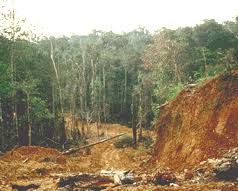
Trees cut down by farmers clearing land to plant their crops : picture by Chitsidzo Muchabayiwa

Soil erosion due to deforestation : picture by Chichi
Trees cut down by farmers clearing land to plant their crops : picture by Chitsidzo Muchabayiwa
Forests cleared in Zimbawe
http://www.cpazimbabwe.org.zw/index.php?option=com_content&view=article&id=8:hardwood-catastrophe-plunder-a-looting-of-zimbabwes-priceless-forest-who-is-eating-trees
Trees cut for poles

Trees cut for poles
Desperate miners are destroying tress
Zimbabwe’s Desperate Miners Ravage the Land
Hard-pressed by economic straits, illegal panners are tearing up Zimbabwe’s countryside in search of gold and diamonds. They leave behind a trail of destruction: devastated fields and forests, mud-choked rivers, and mercury-tainted water.Zimbabwe's desperate miners ravage the land

Cutting down tress will turn Zimbabwe into a desert
Re-settled citizens are cutting down tress clearing their lands and stands. Since a number had to clear land for their fields, this found its way into deforestation as people cut trees.People must stop cutting down trees and farmers must plant trees (afforestation and reforestation) in their farms.The long-term sustainability of land, as an ecological asset, will depend on sound measures that should be taken to protect it as national heritage for all Zimbabweans. There IS deforestation of woodlands, stream bank cultivation, squatting on newly acquired land, poor layout of arable lands, creation of foot and cattle paths, destruction of game, overstocking, road destruction, bush encroachment and veld fires (Madanhi, 2010). Deforestation continues and is exacerbated by re-settlement programs in Zimbabwe today. There is fear that desert like conditions like those already existing in the Seke–Chihota communal area may be experienced in more areas if the problem of deforestation is not seriously addressed. The more Environmental Managemental Agency (EMA) is trying to curb deforestation by planting trees and doing awareness campaigns the more people are continuing to cut down tress. The non-appointment of forestry officers had a negative impact on deforestation (awareness programmes and tree harvesting) as some districts like Zaka, Lupane, Hurungwe and Kariba went for more than 2 years without forestry officers.
Illegal miners are causing deforestation
Illegal miners use various methods interchangeably from open pit, riverbank, to bed panning. The operations are characterized by shallow diggings along the reefs. The open cast mine practice is initially cheap but is not sustainable as mining usually stops at about a depth of 20 m because of hoisting problems and inability to de-water.
The illegal miners cut down tress first to clear their mining area.
These small scale or illegal miners are mostly found in Gwanda. People are making a living through mining. They said they are indulging in these illegal mining activities because there are no jobs in Zimbabwe and also they do not afford a license. ZIMRA is demanding more license fees which they do not afford.

Illegal miners in Gwanda
Illegal miners in Kadoma- Chakari.
Miners cut down trees in search of gold
Illegal miners in Kadoma- Chakari.
Miners cut down trees in search of gold
Thursday, 5 March 2015
Veld fires contributing to deforestation in Zimbabwe
Veld fires contributing to deforestation in Zimbabwe
Last year, the Forestry Commission embarked on a vigorous tree re-planting exercise that meant to see a total of 10 million trees planted countrywide. Although the target was met, it is most likely that the bulk of the newly planted trees have since been wiped out by veld fires.
Trees which were destroyed by fire take long to recover and sometimes they will not recover again.
Trees damaged by veld fires in Masvingo
Zimbabwe is one of the top ten countries facing deforestation in the world.
Tobacco farming also to blame
The most serious threat to what’s left of the country’s forests seems to
be the tobacco farming industry, which is (ironically) being hailed as a
huge success, following the land reform programme.
The new crop of tobacco farmers, most of whom are still small-scale,
insist they cannot yet afford to purchase coal to use in curing their
crop.
As a result, they have been cutting down trees to use in the curing
process. Furthermore, they mostly target indigenous trees, which burn
for longer.
Makoni district in Manicaland
is dominantly a tobacco-farming area, if you visit there you could see large amounts of
indigenous trees piled at almost every farm visited.
In an effort to curb the practice, a statutory instrument was drafted
that would require each tobacco farmer to have a personal woodlot on
his farm, from which he would collect wood for curing the crop.
But because the policy has not yet been made mandatory, most farmers have evidently chosen to ignore the initiative.
In the meantime, Zimbabwe remains one of the top 10 countries facing deforestation in the world.
Trees cut fo firewood
There are a number of activities taking place that would help explain
why the country continues to lose trees. Because the government has to
date still not managed to provide enough electricity to its people,
trees continue to be cut to sustain energy needs.
Going around the country’s highways, bundles of firewood (most of it
from indigenous trees) can be seen the whole way. The sale of firewood
has become big business in Zimbabwe and will continue to be as long as
electricity remains a problem.
There are reports that people who recently invaded Save River Conservancy, are seen frequently transporting truck-loads of cut down (indigenous) trees for sale as firewood in Masvingo.
Wednesday, 4 March 2015
Causes for concern
The Booming Zimbabwe tobacco sector and massive deforestation
Farmers must be blamed for causing deforestation in Zimbabwe
There has been a sharp increase in tobacco production in Zimbabwe
over the last four years, mainly from smallholder farmers who were the
beneficiaries of the fast-track land reform programme in the early
2000s. This increased production has been happening against the
backdrop of massive deforestation in the countryside, which is a cause
for concern. Is the country prepared to face the inherent environmental
challenges of embracing the mainstreaming of previously disadvantaged
people into the tobacco sector?
Smallholder tobacco production in Zimbabwe
According to Consultancy Africa Intelligence (CAI) the tobacco sector, previously dominated by the white, large scale
commercial farmers, has historically made a critical contribution to
the country’s gross domestic product (GDP). There has been an increase
in the number of new smallholder farmers joining the tobacco-growing
sector in Zimbabwe. For instance, in comparison with the 2012 growing
season, the number of tobacco growers registered in the 2013 growing
season increased by 22,000 to 64,775.(3) More than 80% of these
registered tobacco farmers come from the smallholder sector, where each
farmer grows an average of 1.3 hectares. The majority of these
smallholder tobacco farmers are beneficiaries of the fast-track land
reform programme that was initiated in the year 2000, with many
women and youths having been empowered in the process.In 2012,
Zimbabwe received US$ 771 million from tobacco exports at an average
price of US$ 5.94 per kilogram (kg), with smallholder farmers having
contributed massively to that production.
Most smallholder farmers are in contract farming arrangements,
where they are attracted by convenient farm inputs. In the 2013
growing season, about 77,910 hectares of land were put under tobacco
production compared to the 56,377 hectares of land in the 2012 season,
showing a 38% increase.Furthermore, in 2013 tobacco production is
predicted to be around 170 million kg, in contrast to the 144.5 million
kg for the 2012 growing season - far higher than the 49 million kg
of the 2008 season. Land Reform Programme
There is a convergence of factors that have contributed to this
surge in smallholder tobacco production. The issue of land as a means
of production is the most critical. The fast-track land reform
programme empowered a number of people who were previously marginalised
by giving them access to land. In addition, with the advent of the
government of national unity came the use of a multi-currency system,
setting aside the local currency from 2009 onwards. This meant that
farmers would directly earn hard currency for their produce, and this
helped to reduce losses attributed to foreign currency regulations – a
situation that prevailed in the preceding hyper-inflation period. The government of Zimbabwe gave land to the people and it did not urge them not to cut down trees. Many farmers are complaining because of climate changes but they are the ones who are causing these climate changes.
Deforestation in Zimbabwe
Deforestation has always been an endemic problem in Zimbabwe, since a
larger proportion of its population is rural and dependent on firewood
as a sole source of household energy. As far back as 1997, the
United Nations Development Programme (UNDP) reported that deforestation
was a major problem facing Zimbabwe, where between “70,000 to 100,000
ha of forest cover [was] declining at a rate of 1.5% per year.” As a
result, from 1990 to 2005, Zimbabwe endured a decline of about 21% in
its forest cover, which amounts to approximately 312,900 hectares.
Back-to-back power outages countrywide have caused people to resort
to the use of firewood as an easy alternative source of energy. This has in turn created a market for firewood - particularly in urban
areas. This high demand for firewood has driven the rate and scale of
deforestation in the countryside, including in newly resettled areas
which were inaccessible to the majority before the wave of land reform
beginning in 2000.
The most unfortunate part is that indigenous trees take a long time
to grow to maturity - between 75 and 150 years – unlike the exotic
eucalyptus trees. Thus, when indigenous trees are cut at ground level,
as is usually the case, they are lost forever. Tobacco farming and veld
fires have also been blamed for driving the process of
deforestation. The connection between tobacco farming and
deforestation of indigenous forests is explained below.
Thursday, 26 February 2015
Images of Deforestation
 Murara tree is under threat in Zimbabwe because is it used to make some medicine.
 Deforestation is causing soil erosion.
http://www.dailynews.co.zw/articles/2013/12/08/cutting-down-trees-is-a-sin
Tuesday, 24 February 2015
Deforestation: a threat to our healthy
Trees help our breathing system. Tress inhale carbon-dioxide and exhale oxygen, and in turn we inhale O2 and exhale CO2.
So if people continue to cut down trees it means there will be no source of O2 for human beings.
When forests are cleared, they emit CO2 back into the
atmosphere and put humanity on a dangerous collision course with the
worst of climate change. According to Meteorologists deforestation is causing climate changes.
Deforestation accounts for about 11% of global
greenhouse gas emissions caused by humans — comparable to the emissions
from all of the cars and trucks on Earth combined.
Trees are important in our environment. When you protect trees you are creating a healthier, more prosperous, more productive environment for you and for everyone.
Thursday, 12 February 2015
What is Deforestation : causes and effects
Deforestation is a consequence of over-exploitation of our natural
ecosystems for space, energy and materials. The basic reasons for such
extensive deforestation are:
(1) Expansion of Agriculture
Expanding agriculture is one of the most important causes of
deforestation. As demands on agricultural products rise more and more land is
brought under cultivation for which forests are cleared, grass-lands ploughed,
uneven grounds leveled, marshes drained and even land under water is reclaimed.
However, this expansion is usually marked with more ecological destruction than
rationality. Governments often distribute land under forests to landless
people, instead of redistributing already established farm-lands, howsoever,
wasteful, unequal and unjust the distribution of ownership of land may be.
(2) Extension of Cultivation on Hill Slopes:
Outside humid tropical zone, in most of the third world countries, major
forests often occur on hill tops and slopes. Though agriculture has nearly
always been concentrated on plains and floors of valleys, farming on narrow
flat steps cut one after another across the slope or terrace farming is an
age-old practice. It has never been extensive because of the grueling labour
and low productivity.
However, the ever rising human numbers and their necessities have forced
many to go up to mountain slopes for cultivation. More and more slopes are
cleared of plants, steps carved out and against many odds cultivation is
attempted. After a few crops the productivity declines and torrential sub-tropical
rains carry down massive quantities of precious top soils to streams and
rivers. While denuding hill slopes, the silt and sediments settle further down
raising stream bottoms and river beds aggravating the flood situation.
(3) Shifting Cultivation:
Shifting cultivation or Jhum is often blamed for destruction of forests.
In fact it is poor fertility of soil which has given rise to such a pattern of
farming. A small patch of tropical forest is cleared, vegetation slashed,
destroyed and burned. Crops are grown as long as the soil is productive, after
which the cultivation is abandoned and cultivators move on to fresh patch of
land.
The abandoned land was allowed to lay fallow for long periods during
which regrowth of vegetation took place and natural ecosystem was restored.
Shifting cultivators, therefore, worked in harmony with nature. However, the
demands of growing population have shortened the fallow periods drastically.
The soil is unable to regain its fertility before it is put to use again.
This causes degradation of soil and failure of crops after crops.
The influx of shifting cultivators in water-shed around Panama Canal has
caused extensive soil degradation resulting in large-scale erosion of the soil.
Future utility of Panama Canal and the Panama City's water supply system are
threatened by massive deposits of silt and sediments. The Government has
launched massive programme of reforestation of the water-shed around Panama
Canal (Lawrence; 1978).
(4) Cattle Ranching:
Large areas of tropical forests in Central and South America have been
cleared for use as grazing land to raise cattles and cash in on the lucrative
beef exports to USA. But | in these cases too, the problem of poor productivity
of tropical soils makes the venture non-viable The soil degenerates within a
short span of time due to over-grazing and massive soil erosion occurs, Cattle
ranching has done much damage to the tropical forest cover in South and central
America (Fearnside 1980, Parson 1976)
(5) Firewood Collection:
To majority of rural population and a large number of people living in
small towns and cities of developing countries, the only fuel is wood which is
burned to cook food and to provide heat in chilly winters. Firewood collection
contributes much to the depletion of tree cover, especially in localities which
are lightly wooded. Denser forests usually produce a lot of combustible
material in the form of dead twigs, leaves etc. There is hardly any need of
cutting down live trees in densely wooded localities.
However, in the case of lightly wooded forests, where the pressure of
demand is usually higher, a slow thinning of woodland occurs due to regular
foraging of villagers. In Madhya Pradesh, India, a recent observation revealed
that felling of small trees for use as firewood and timber exceeds fresh plant
growth. In some places in the state, the Government! Allows people to collect
head loads of dead wood from forests for personal use.
However, deadwood is actually manufactured, trees are axed, and their
barks girdled and live trees become personal head loads to find their way to
local markets. If the present trend continues, within twenty years, it is
feared that half of the State which has the largest area under forests in
India, will become treeless (Tomarand Joshi 1977).
Outright felling of live trees to meet firewood and charcoal requirement
is common in lightly! wooded areas in many countries. In Upper Voltas, Sudan,
Nigeria etc. well organized gangs exist which cut live trees in widening
circles around towns and cities, illegally convert them into charcoal for sale
in cities. In Sudan authorities have to use armed guards to protect live trees
and armed clashes are common.
(6) Timber Harvesting:
Timber resource is an important asset for a country's prosperity.
Commercial wood finds ready national as well as international markets. As a
consequence of which natural forests are being mercilessly exploited. Logging
or felling of forest trees for obtaining timber is an important cause of
deforestation in third world countries.
Live trees with thick and straight trunks are felled and transported to
commercial establishments elsewhere, to consumers who are ready to pay. In the
process large stretches of forests are damaged and the system which could have
provided resources worth much more to the local people is disrupted. Ironically
the profits from timber trade are enjoyed by Governments, large companies or
affluent contractors. Local people get a tiny share in the benefits while axing
their own resource base.
Commercial logging in tropical countries usually involves felling of
trees of only selected species which fetch better prices. This process of
creaming or removing a few selected trees amidst dense vegetation on rather a
delicate soil causes much more destruction than the actual number of trees or
the volume of timber taken out would suggest.
In a study in Indonesia, it was found that the logging operations
destroyed about 40% of the trees left behind. In many third world countries
logging operations have been observed to lead to a permanent loss of forest
cover. Loggers after removing a select group of trees move on to other areas.
They are usually followed by others who move into the cut over area hoping to
start farming and put down roots. The remaining vegetation is slashed and
burned and agriculture is attempted. When cultivation fails it is replaced by
cattle ranching or by useless tenacious grasses.
The selective harvesting practiced by loggers leave many forests
permanently deficient in valuable plant species. Much of the West Africa has
become useless for commercial logging as important plant species required by
the loggers are not available. In Philippines, the valuable groups of tall
trees (Dipterocarpus sp.) have shrunk from original 16 million hectares in
1960, to about one million hectares left standing in remote regions.
The practice of cutting down larger trees, of the selected species,
leaving behind younger ones which can grow into fresh stock to be harvested
later may appear rational. In theory such patch should become ready for
re-harvesting within thirty to forty years. However, in practice none of the
loggers leaves the required number of younger trees and the notion that the
woodland shall be ready for another valuable timber harvest in forty years
appears to be a wistful thinking at its best.
In East Kalimantan, the seat of Indonesia's lucrative timber trade
logging firms are required to leave behind 25 select crop trees per hectare but
in practice none does so and the entire logged out area degenerates into a
useless waste land. Of 17 million hectares of rich tropical forests, about 13
million hectares were marked for logging in 1978 by as many as 100 licensed
companies. In Brazil also the select fell system which leaves behind younger
plants for natural regeneration is being tried with an intensive re-plantation
drive. However, if we look at the recent history of tropical forest
exploitation, it appears that most of tropical timber is being harvested like a
non-renewable resource (Johnson and Dykstra, 1978).
Subscribe to:
Posts (Atom)